

You are looking at a new platform because client work keeps starting late. The demo is good. It has reminders, dashboards, and the integrations your current setup is missing.
Before deciding, follow one late job through your business. Find the point where it stopped and write down what it needed to move.
That is where I would start an operations decision. A new tool makes sense when its capabilities address the observed constraint and your team can put them to use.
Consider an illustrative example from a content agency. Its workflow has five steps: qualify the lead, approve the scope, request client inputs, confirm those inputs, and start production.
The founder thinks the project system is slowing everyone down. A closer look shows that work is waiting between requesting the inputs and confirming they are complete. The client received “send your assets,” and the account manager has no agreed list of what that means.
Changing platforms would still leave somebody deciding whether the footage, brand guide, and approvals are sufficient. I would first define the required inputs and name the person who accepts them. Then I would check the next few clients against that rule.
If the inputs are already complete and somebody spends an hour copying them into the project system, the case for an integration is stronger. If the current tools cannot support a required client approval process, replacing or adding software may be justified.
Each intervention solves a different condition. The decision should follow the evidence you find in the workflow.
Anthropic recommends starting with a simple solution and adding complexity when it improves outcomes in the context of AI systems. For your operations, describe the constraint, test a proportionate change, and measure whether work moves more reliably.
The accompanying decision matrix compares a process adjustment, an integration, and a new tool. It asks for evidence and a small next step beside each option. An unclear problem stays in the diagnosis column until there is enough information to choose.
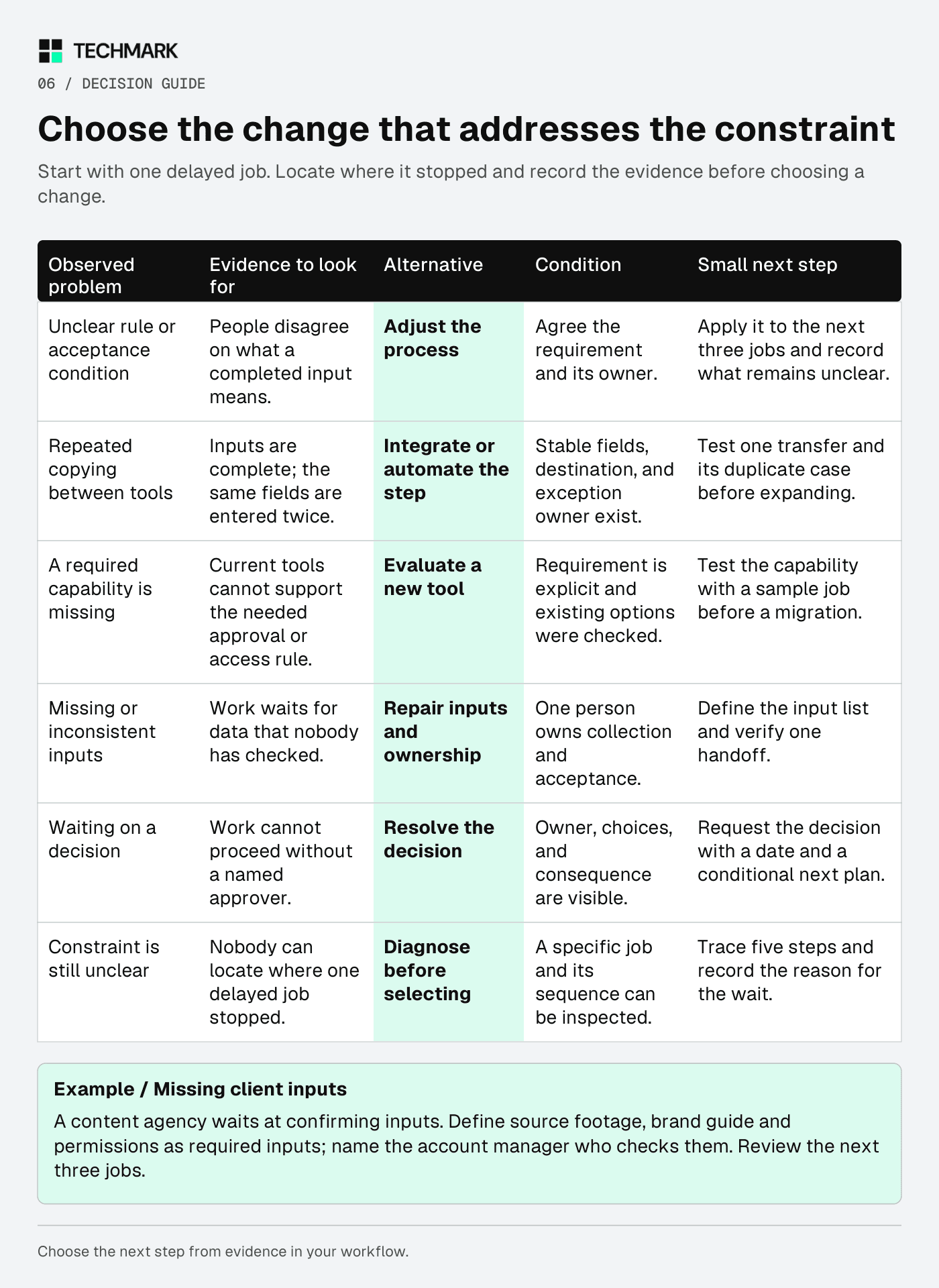
Match the problem with a process change, an integration, or a new tool.
Automating a defined step can remove repeated handling. Sometimes the work first needs a clearer rule, better inputs, or a decision from the founder. Those conditions determine whether the automation will help.
Before your next software decision, draw the five steps of one delayed job. Circle the step where it waited. Write a sentence describing what prevented it from moving, then choose the smallest change that could resolve that condition and a way to check the result.
Resources
You are looking at a new platform because client work keeps starting late. The demo is good. It has reminders, dashboards, and the integrations your current setup is missing.
Before deciding, follow one late job through your business. Find the point where it stopped and write down what it needed to move.
That is where I would start an operations decision. A new tool makes sense when its capabilities address the observed constraint and your team can put them to use.
Consider an illustrative example from a content agency. Its workflow has five steps: qualify the lead, approve the scope, request client inputs, confirm those inputs, and start production.
The founder thinks the project system is slowing everyone down. A closer look shows that work is waiting between requesting the inputs and confirming they are complete. The client received “send your assets,” and the account manager has no agreed list of what that means.
Changing platforms would still leave somebody deciding whether the footage, brand guide, and approvals are sufficient. I would first define the required inputs and name the person who accepts them. Then I would check the next few clients against that rule.
If the inputs are already complete and somebody spends an hour copying them into the project system, the case for an integration is stronger. If the current tools cannot support a required client approval process, replacing or adding software may be justified.
Each intervention solves a different condition. The decision should follow the evidence you find in the workflow.
Anthropic recommends starting with a simple solution and adding complexity when it improves outcomes in the context of AI systems. For your operations, describe the constraint, test a proportionate change, and measure whether work moves more reliably.
The accompanying decision matrix compares a process adjustment, an integration, and a new tool. It asks for evidence and a small next step beside each option. An unclear problem stays in the diagnosis column until there is enough information to choose.

Match the problem with a process change, an integration, or a new tool.
Automating a defined step can remove repeated handling. Sometimes the work first needs a clearer rule, better inputs, or a decision from the founder. Those conditions determine whether the automation will help.
Before your next software decision, draw the five steps of one delayed job. Circle the step where it waited. Write a sentence describing what prevented it from moving, then choose the smallest change that could resolve that condition and a way to check the result.